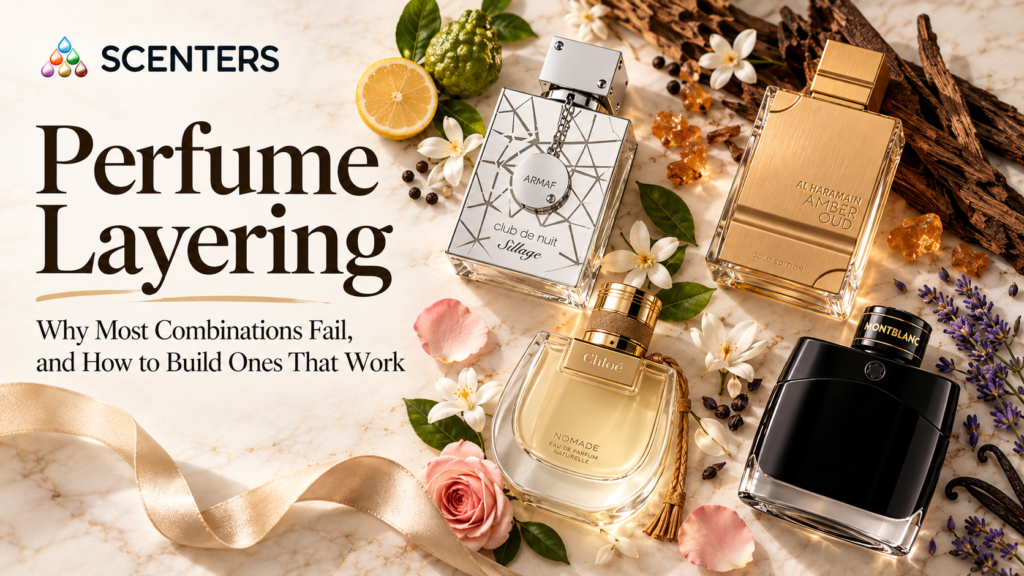
Perfume Layering: Why Most Combinations Fail, and How to Build Ones That Work
What Is Perfume Layering?
Perfume layering means wearing two or more scented products at once to create a combined effect. That includes pairing a fragrance with a matching body lotion, wearing two fragrances together, or applying a perfume oil beneath a spray. The aim is a result neither bottle produces alone.
There are three levels of it, and they carry very different levels of difficulty.
| Level | What it involves | Difficulty |
| Supporting | Unscented moisturiser under fragrance | None — this is just good practice |
| Reinforcing | Matching body wash, lotion and fragrance from one line | Low — designed to work together |
| Combining | Two different fragrances worn together | High — most failures happen here |
Most people jump straight to level three, which is the only one with a meaningful failure rate.
Why Most Layering Combinations Fail
The most common failure is layering two complex fragrances. Each one already contains a full structure of top, heart and base notes, and putting two complete compositions on the same skin produces competition rather than combination. The result usually smells muddy rather than new.
Failure one: both fragrances are busy
A fragrance is already a carefully balanced arrangement of fifteen to sixty materials. Two of them together is not thirty materials in harmony it is two structures fighting for the same space.
The fix: keep at least one of the two simple. A single-note soliflore, a clean musk, a straightforward vanilla or a plain citrus gives the other fragrance room to lead.
Failure two: the bases conflict
Base notes are where layering is decided, because they last longest and sit underneath everything.
Two fragrances with a shared base both vanilla-anchored, or both amber-anchored, or both built on clean musk merge smoothly, because the foundation is consistent and only the upper layers differ.
Two fragrances with opposing bases a sweet gourmand and a dry vetiver, or an aquatic and a heavy oud — do not merge. They sit next to each other, and you smell both separately.
Failure three: doubling the sprays
This is the most common practical mistake.
If you normally wear three sprays of a fragrance, layering two does not mean three sprays each. Six sprays of anything is too much, and the result is overwhelming regardless of how well the two scents would otherwise work.
The fix: two sprays of the base, one of the top. Total output should be roughly what you would wear alone, not double it.
Failure four: applying them at the same moment
Spraying one immediately on top of the other mixes them before either has settled. The alcohol from the second disturbs the first while it is still evaporating.
The fix: thirty seconds between layers. Let the first dry before the second goes on.
Failure five: expecting it to be louder
Layering is not a volume control. The best combinations are frequently more subtle than either fragrance alone, because one softens the edges of the other.
If you are layering to be noticed more, you probably want a different fragrance rather than two.
The Rules That Make a Combination Work
Share a base, contrast the tops. Apply the heavier fragrance first and let it settle. Keep one of the two simple. Reduce your total sprays. Those four principles account for almost every successful combination.
Rule one: shared base, contrasting top
This is the single most reliable guide.
Shared base gives cohesion. Both fragrances resolve into the same foundation, so the drydown is coherent rather than confused.
Contrasting top gives interest. If the openings are also identical you have simply made one fragrance slightly stronger, which is not layering it is over-application.
| Base they share | Top that works over it | Result |
| Vanilla | Citrus or fresh aromatic | Warm with a bright opening |
| Amber | Floral | Rich, rounded, classic |
| Clean musk | Almost anything | Softened, skin-like version of the top scent |
| Woods | Sweet or gourmand | Depth with an edible top |
| Patchouli | Rose or fruit | The classic chypre-adjacent structure |
Rule two: heavier first, lighter second
Apply the heavier fragrance the parfum, the EDP, the gourmand or woody one directly to skin. Let it settle. Then apply the lighter one over it.
Why this order matters: the heavier fragrance needs direct skin contact to develop properly, and its base notes do the anchoring. A light citrus applied first would simply evaporate under the weight of what follows.
Rule three: one simple, one complex
A clean musk, a plain vanilla, a single-note rose or a straightforward citrus is the ideal partner for a complicated fragrance. It modifies rather than competes.
Two complex fragrances together is the single most common reason layering fails.
Rule four: reduce the total
Two sprays of the base, one of the top. If that feels too light, the problem is usually your skin rather than the quantity — the longevity guide covers why fragrance fades faster on some people and what to do about it.
Combinations That Work, by Category
These are structural combinations rather than specific bottles, which means they still apply when a particular fragrance is reformulated or discontinued.
Vanilla base + citrus top
Why it works: the citrus lifts an opening that vanilla alone would make heavy, and the vanilla gives the citrus somewhere to land instead of disappearing in an hour.
Best for: daytime in cool weather, or anyone who finds pure gourmands too sweet.
Clean musk base + anything
Why it works: a soft white musk is the most forgiving base in layering. It adds warmth and skin-like softness without imposing a direction.
Best for: softening a fragrance that feels too sharp, too loud or too synthetic.
Woody base + gourmand top
Why it works: the woods give structure and dryness; the sweetness sits on top without becoming cloying. This is the combination that produces the “expensive” impression people chase.
Best for: evenings, autumn and winter.
Amber base + floral top
Why it works: amber is warm and slightly powdery, which flatters almost any floral and makes a simple one feel more complex.
Best for: formal occasions, and for making an inexpensive floral feel richer.
Rose + oud, or rose + patchouli
Why it works: these are classical pairings that perfumers have used for a century, because the earthiness grounds the sweetness of rose and stops it becoming powdery.
Best for: anyone who finds rose fragrances too pretty on their own.
Fresh aquatic + warm spice
Why it works: the contrast is the point. A clean marine opening over a spicy base reads as unexpected rather than incoherent, because the two occupy different parts of the structure.
Best for: transitional seasons, when neither a summer nor a winter fragrance is quite right.
Combinations to Avoid
| Combination | Why it fails |
| Two heavy gourmands | Sickly within an hour; no contrast anywhere |
| Two complex orientals | Both demand the foreground; neither gets it |
| Aquatic + heavy oud | The bases are structurally incompatible |
| Two strong florals | They blur into something generic rather than combining |
| Anything + a fragrance you already find too strong | Layering never reduces projection |
The general pattern: combinations fail when both fragrances want the same role. One has to lead.
How to Test a Combination Properly
Apply the combination to one wrist and the base fragrance alone to the other. Check at thirty minutes, two hours and four hours. The four-hour check matters most, because that is where the bases interact and where most combinations either resolve or fall apart.
Why one wrist each
Comparing the combination against one of its components tells you whether layering actually improved anything. Quite often it has not and without the control you would never know.
What to look for at each stage
| Interval | What you are judging |
| Immediately | Whether the openings clash |
| 30 minutes | Whether one fragrance has disappeared under the other |
| 2 hours | Whether the hearts are working together or separately |
| 4 hours | Whether the bases have merged or are sitting side by side |
The four-hour test is the real one. A combination that smells interesting at ten minutes and muddy at four hours is a failed combination and four hours is most of the time you will actually spend wearing it.
Ask someone else
Olfactory adaptation means you stop registering both fragrances within twenty to thirty minutes. Someone smelling both wrists will tell you more than you can tell yourself.
Layering With Body Products
The easiest and most reliable form of layering is matching body products with a fragrance, because they were formulated to work together. A scented shower gel and body lotion from the same line extend wear substantially and require no judgement about compatibility.
Why it works so well
Fragrance houses design these as a system. The body products use a simplified version of the fragrance, which reinforces the base without competing with it.
Order: shower gel, towel dry, body lotion, let it absorb for a minute, then the fragrance.
The unscented option
If you do not have matching products, an unscented moisturiser achieves most of the longevity benefit without any risk of clashing. On dry skin this alone can add two to three hours.
Avoid scented lotions from a different line. They are the most common accidental layering mistake — a vanilla body cream under a fresh citrus fragrance quietly undermines both.
This is also why sets pairing a fragrance with matching body products are genuinely useful rather than packaging filler.
Layering Perfume Oils Under Sprays
A perfume oil applied first and a spray over it is one of the more effective layering methods, because the oil anchors to skin and the spray projects. The oil extends the wear and the spray provides the opening.
Oils contain no alcohol, so they sit close to the skin and release slowly. A spray applied over one has something to hold it in place.
Two cautions: apply less of both than you would alone, and do not use the oil and spray version of the same fragrance expecting double the effect. The formulations are usually balanced differently, and the result is rarely what either was designed to be.
Where to Apply Each Layer
Apply both layers to the same points for a blended result, or to different points for a scent that shifts as you move. Blended is more predictable; separated is more interesting and harder to control.
Same points blended
Both fragrances on wrists, neck and chest. They merge into a single impression. This is the approach to start with.
Different points separated
Heavier fragrance on the chest and lower body, lighter on the neck and wrists. The result changes depending on which part of you someone is closest to.
This is more advanced and less predictable. It works well for evenings and badly in close quarters like an office or a car, where someone experiences both at once without the blending.
Layering by Season
The same combination behaves differently across the year, because heat amplifies fragrance and cold suppresses it. A pairing that is balanced in November can be overwhelming in July, and one that works in summer can disappear entirely in winter.
Spring
Light florals over a clean musk, or a green note over a soft vanilla. The aim is lift rather than weight.
Reduce to one spray of each. Spring weather is unpredictable, and a combination applied for a cool morning becomes too much by a warm afternoon.
Summer
This is the season to layer least. Heat lifts fragrance molecules faster, which means more projection from less product. A combination that sits close in December fills a room in August.
If you do layer in heat, keep both elements light — a citrus over a clean musk, or an aquatic over a soft woody base. Avoid gourmands entirely.
Autumn
The best season for layering, and the one where most combinations work. Temperatures are moderate enough that fragrance projects without amplifying, and the heavier families come back into use.
Woody bases with gourmand or spiced tops. Amber bases with floral tops.
Winter
Cold suppresses projection, which means you can carry combinations that would be unwearable in summer.
This is where heavy pairings earn their place vanilla with woods, amber with spice, oud with rose. Indoor heating complicates it, so if you spend the day in a warm office, apply as though it were autumn.
Layering for Specific Occasions
| Occasion | Approach | Total sprays |
| Office | Clean musk base, light top. Low projection throughout | 2 |
| Daytime, outdoors | Fresh over soft woody. Room to breathe | 2–3 |
| Evening, formal | Amber or woody base, floral or spiced top | 3 |
| Date | Warm base, something distinctive on top | 2–3 |
| Travel | Do not layer. Enclosed cabins have no tolerance for it | — |
The office rule is worth stating directly: if a colleague can identify your fragrance from a metre away, you have applied too much, and layering makes this considerably easier to get wrong.
When Not to Layer
Several situations where the answer is simply one fragrance.
When the fragrance is already complex. A well-constructed niche fragrance with a developed structure does not need help, and most attempts to improve it make it worse.
In an office or any enclosed space. Layering increases total output even when you reduce sprays, and shared air has a low tolerance for experimentation.
In hot weather. Heat amplifies everything. A combination that works in November can be overwhelming in July.
When you have not tested it. Layering an untested combination before an event is a genuine risk, because unlike a single fragrance you cannot predict the drydown from experience.
When you are trying to fix a fragrance you dislike. Layering does not rescue a fragrance that does not suit you. It produces a scent that is partly one you dislike.
Layering as a Way to Use What You Own
Worth saying plainly, because most guides on this subject exist to sell you a second bottle: layering is at its most useful as a way to get more out of fragrances you already have.
Three bottles produce three fragrances. The same three bottles, layered in pairs, produce several more — some of which will be better than any of the three alone.
Before buying anything to layer with, work through the combinations already in your collection. Most people find at least one pairing they would not have predicted.
When you do want to add something specifically for layering, a simple clean musk or a plain vanilla is the most useful single purchase. Both work with almost everything, and neither competes.
Our guides to choosing a fragrance for men and for women cover how to identify which families suit you, and how perfume notes work explains the base-note logic that makes layering predictable rather than accidental.
Common Questions, Answered Directly
Can you layer two fragrances from different brands? Yes, and most good combinations are. Brand has no bearing on compatibility base notes do.
Does layering make fragrance last longer? Usually yes, but indirectly. Two fragrances means more material on skin, and if the base layer is a heavier concentration it anchors the lighter one. Matching body products extend wear more reliably than a second fragrance does.
Can men and women layer the same way? Yes. Gendered marketing is a commercial convention rather than a chemical one, and the base-note logic is identical regardless of which section the bottle was sold in.
Should you layer on clothes or skin? Skin. Fragrance is designed to develop against skin warmth, and layered on fabric you get a flattened version of both — plus double the stain risk.
Can you mix two fragrances in one bottle? Not advisable. Fragrances are balanced as finished products, and combining the liquids produces unpredictable results that cannot be undone. Layering on skin is reversible; a mixed bottle is not.
How many fragrances can you layer at once? Two. Three occasionally works if two of them are very simple, but the failure rate rises sharply and diagnosing what went wrong becomes impossible.
Does the order really matter? Yes. The heavier fragrance needs direct skin contact to develop and anchor. Reversed, the lighter one is buried and the heavier one has nothing to hold it.
A Note on What Layering Cannot Do
It is worth being direct about the limits, because a great deal of layering content implies there are none.
Layering will not make a fragrance you dislike into one you like. It produces a combination that is partly a fragrance you dislike.
It will not rescue a fragrance that disappears on your skin. If a scent vanishes in two hours, adding a second one gives you two fragrances that vanish in two hours. The cause is almost always skin dryness or a light composition, and neither is solved by layering.
It will not make a cheap fragrance smell expensive. The materials are what they are. A good combination can make a simple fragrance more interesting, which is not the same thing.
And it will not reliably produce something better than both components. Quite often the honest answer after testing is that one of the two was better alone. That is a successful experiment, not a failure you have learned something about your collection for the cost of a day’s wear.
The Short Version
Share a base, contrast the top. Two fragrances with the same foundation merge; two with opposing foundations sit side by side.
Heavier first, thirty seconds, then lighter. Order and timing both matter.
Keep one of them simple. Two complex fragrances together is the most common reason layering fails.
Reduce your sprays. Two of the base, one of the top. Not three of each.
Judge it at four hours. That is where the bases interact, and where a combination either works or does not.
And if the result is not better than either fragrance alone, wear the better one. Layering is a tool, not an obligation.
Browse the full fragrance collection if you are looking for a simple base scent to layer with.